The Latest Updates, Perspectives and Stories From MatrixSpace

8 Ways Combined Radar and Drone Solutions Can Improve Rail Safety and Security
Railyards and rail lines face significant challenges daily—from theft, vandalism, and costly derailments. Technology enables securing their perimeters more effectively while also improve asset inspection practices.
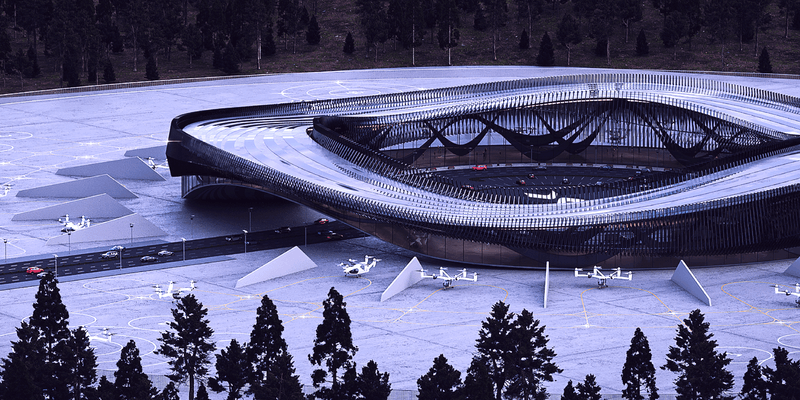
Advancing Air Mobility: The Skyway and MatrixSpace Partnership
We recently announced a joint venture with Skyway to advance the integration of intelligent air traffic management and uncrewed aircraft detection systems. Skyway develops vertiports and provides advanced solutions for vertiport traffic management and unmanned airspace planning. MatrixSpace provides outdoor sensor solutions leveraging radar technology for use in defense and commercial applications, which addresses this need. The companies’ partnership is intended to support several aspects of enabling practical advanced air mobility (AAM) initiatives in the United States.

The Urgent Need for Low Altitude Awareness in the National Airspace
The recent New Jersey drone panic has made it clear: people want to know what’s flying in low altitude airspace. Why can’t we provide the level of clarity demanded? What’s needed to make it happen?

The Case for Drone Operations Above 200' with Airspace Sensors
While some industry influencers argue DFR operations are best run up to 200 feet above ground under shielded conditions (only), we explore the risks of this practice as well as the benefits of extending operational altitude with airspace sensors.

L3Harris: The Future of Tracking and Defeating Drones
L3Harris recently collaborated with MatrixSpace to demonstrate how the companies’ novel technologies can be combined to provide a ground-breaking, low-cost solution to detecting, identifying, and tracking drones.

With MatrixSpace Radar, Campbell Police Department expands DFR Program to single person operations, flying day and night at higher altitudes
Expanding its pioneering Drone as First Responder (DFR) program, Campbell…

The New Frontier of Port Security
Nautical ports have historically been the primary means for large volumes of cargo and people, including intercoastal shipping from local ports or from ports across the world.

Drone Detection: The Growing Drone Threat to Prisons
In the ever-evolving landscape of prison security, the advent of drone technology has introduced new challenges.

Protecting Air Corridors at Regional Airports
While there’s a lot of attention given to drone detection and counter drone solutions, we also hear from customers about the need for higher levels of ground and air surveillance in the general aviation space.
Latest News


MatrixSpace strengthens executive team
Counter-drone tech specialist MatrixSpace has appointed industry veteran John Bagocius head of sales. John Bagocius brings more than two decades of leadership experience, spanning commercial growth, strategic partnerships and mission enablement, including senior positions at Draganfly, Aeryon Labs, FLIR Systems and Crossmatch (HID).

Policing with drones in Palm Springs, California
Lieutenant William Hutchinson, Palm Springs Police Department, Real Time Intelligence Center (RTIC) & Drone as First Responder (DFR) Program Director spoke with Global Airspace Radar about the programme. This represents the largest DFR programme in the United States, covering 37 square miles (or roughly 60 square kilometres).

Drone Data Under the SAFER SKIES Rule
The rule gives SLTT agencies real counter-UAS authority for the first time. It also places data squarely at the center of that authority. For technology providers building the systems agencies will actually use, that data architecture is where compliance either works in practice or breaks down.
Army, Industry Hack Away at Linking Traditionally Stovepiped Systems
Beginning in May, hundreds of Army technical experts, operational personnel and defense industry representatives gathered at Fort Carson, Colorado, to take part in a month-long hackathon dubbed Operation Jailbreak. The goal of the event was to enable combat systems that have traditionally been disconnected to share data in real time.

Matt Kling joins SIA subcommittee on drone security
MatrixSpace’s Matt Kling has joined the Security Industry Association’s (SIA) Drone Security Subcommittee. SIA is a trade association for global security solution providers with over 1,700 member companies. The Subcommittee educates the security industry on counter-ucrewed aerial systems (C-UAS) legalities, technologies, training and options to mitigate UAS attacks. The Subcommittee supported the SAFER SKIES Act, approved by the United States Congress in December 2025, and executive branch recommendations such as the Domestic C-UAS National Action Plan and the executive order on Restoring American Airspace Sovereignty.