The Latest Updates, Perspectives and Stories From MatrixSpace

The Case for Drone Operations Above 200' with Airspace Sensors
While some industry influencers argue DFR operations are best run up to 200 feet above ground under shielded conditions (only), we explore the risks of this practice as well as the benefits of extending operational altitude with airspace sensors.

L3Harris: The Future of Tracking and Defeating Drones
L3Harris recently collaborated with MatrixSpace to demonstrate how the companies’ novel technologies can be combined to provide a ground-breaking, low-cost solution to detecting, identifying, and tracking drones.

With MatrixSpace Radar, Campbell Police Department expands DFR Program to single person operations, flying day and night at higher altitudes
Expanding its pioneering Drone as First Responder (DFR) program, Campbell…

The New Frontier of Port Security
Nautical ports have historically been the primary means for large volumes of cargo and people, including intercoastal shipping from local ports or from ports across the world.

Drone Detection: The Growing Drone Threat to Prisons
In the ever-evolving landscape of prison security, the advent of drone technology has introduced new challenges.

Protecting Air Corridors at Regional Airports
While there’s a lot of attention given to drone detection and counter drone solutions, we also hear from customers about the need for higher levels of ground and air surveillance in the general aviation space.

A Nervous System for Sensors
In the past twenty years, we’ve seen amazing advances in sensors of many varieties.

The Primer on Surveillance vs. Declaration vs. Operational Volume, for Advanced Drone Operations
There’s a common misconception in the UAS industry when talking about surveillance and operational volumes for UAS operations.

Ground-Based Surveillance Systems (GBSS) for BVLOS DFR Operations
A limitation in UAS operations for DFRs (Drone as First Responder) programs is the requirement for visual line-of-sight (VLOS) of the Remote Pilot in Command (RPIC).
Latest News


Inside the G-TEAD Marketplace: The Army's New Fast Lane for C-UAS Tech
The US Army is standing up a new "fast lane" for counter-UAS and tactical edge systems, and it's starting to fill up. Built around live experimentation, prize challenges and a European-based marketplace, the model aims to move vetted systems from demo to delivery in months instead of years for both U.S. and NATIO forces.
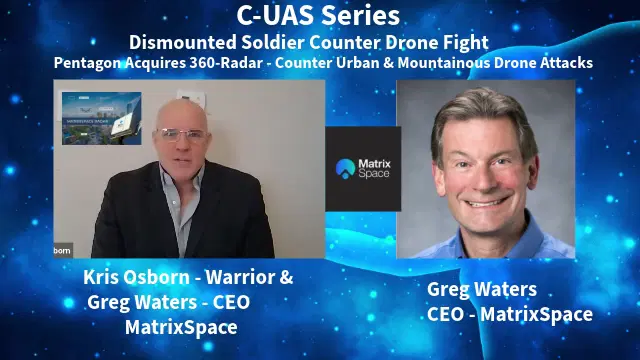
Dismounted Soldier Counter Drone Fight
“MatrixSpace finally brings to fruition a long-held goal of the military for agile, robust networked detection. The military is accomplishing what it has long sought after for decades, this idea of dismounted, non-fixed, network-programmable radar across otherwise dispersed, non-linear kinds of environments.”

MatrixSpace wins C-UAS Low-Cost Sensing Challenge
Winners of the U.S. defense Counter-small Unmanned Aircraft System (C-sUAS) Low-Cost Sensing (LCS) challenge have been announced. MatrixSpace Inc. was selected as the overall winner and will receive the top award of $500,000. Following the overall winner, the top three performers — Guardian RF, Hidden Level and Teledyne FLIR Defense — will each receive award amounts of $100,000.

MatrixSpace Wins DIU, JIATF-401, USNORTHCOM, US ARMY C-UAS Low-Cost Sensing Challenge
The Defense Innovation Unit (DIU), in close collaboration with U.S. Northern Command (USNORTHCOM), Joint Interagency Task Force 401 (JIATF-401), U.S. Army, U.S. Navy, U.S. Marine Corps, and U.S. Indo-Pacific Command, announced top-performing solutions for the Counter-small Unmanned Aircraft System (C-sUAS) Low-Cost Sensing (LCS) challenge.

MatrixSpace Introduces Portable 360° Radar for Rapid, Resilient Counter-Drone Detection
MatrixSpace, a leader in portable AI-enabled radar for counter-UAS (C-UAS) applications, announced the availability of its new Portable 360 Radar™, a rugged, highly mobile system designed to deliver reliable close-airspace awareness with full panoramic coverage.